Posts

Wing and a Prayer: The Elusive Control Dream of Genetically Modified Foods

Wing and a Prayer: The Elusive Control Dream of Genetically Modified Foods      Animals, including humans, strive to find the easiest path forward through life's forests and pastures. We often go to great lengths to make the trek forward of greater value and less risk to ourselves and others. So it is with genetically modified (GM) foods: Just as with great challenges in the past, we are embracing the difficult objective of producing more food for an exponentially populating world. In doing so, like our grandparents, we undauntedly move forward into the battle and frequently return "Comin' in on a Wing and a Prayer" (The Song Spinners, 2014).      We are early in the battle, and our new GM food weapons are beginning to run foul like a jammed chamber. As Hakim (2016) reports, GM crops in the United States are not significantly increasing yield as compared to non-GMO European equivalents. In addition, contrary to claims proffered by corporate GM crop producer...
Stem Cell Ethics Synthesis and Evolution

  Stem Cell Ethics Synthesis and Evolution      Life begets life. Our current biological understanding of life is that a living entity must be able to reproduce in some fashion -- be able to create a new and similar individual of its own ilk. This is true for all forms of life be they bacterial, frogs, trees, doves, or humans. There is an innate biological intent within all living beings to replicate. The natural course of this process, barring the intervention of humans into the replication process of living things, produces much waste of potential life.      In nature not all tree seeds produce trees, not all animal conceptions create new animals, and not all human ovum result in children. In a natural state, nature reabsorbs and reuses the germs of life, as is demonstrated by most tree and plant seeds being broken down into constituent elements and reused by nature. The observed intent of nature is not for all embryos to become autonomous beings, mo...

Glycosylation of HxNx Avian Flu HA Protein

Image
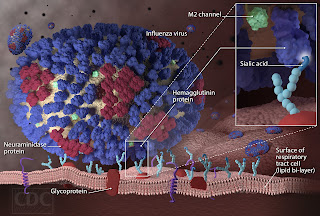
  Glycosylation of HxNx Avian Flu HA Protein      Recently, there is great concern regarding the repeated occurrence of highly pathogenic avian influenza virus (HPAIV) in domestic poultry and increasingly in humans worldwide. Specifically, the H5N1,H5N6, and H7N7 avian viruses have come into focus as having a high potential of becoming virulent in humans (Gao et al., 2019; Igarashi et al. 2019; Yang et al., 2009). Human cases of HPAIV have occurred frequently in China, Indonesia, and Vietnam over the last couple of decades but recently new cases have begun to appear worldwide (Gao et al., 2019). In April of 2021 a male in Colorado was reported to have contracted an H5 influenza strain, presumably H5N1 (Centers for Disease Control and Prevention [CDC], 2021d). Countries worldwide have culled countless flocks of affected poultry in an effort to stem the potential cross-over of the disease to humans and recently, record numbers of poultry are dying from avian flu (Polan...

Retinal Ganglion Cells - Forthcoming Restoration of Epigenetically Induced Damage

  Forthcoming Restoration of Epigenetically Induced Damage to Retinal Ganglion Cells Retinal ganglion cell degeneration is one the baseis for a number of ocular neuropathies and diseases, including glaucoma (Corral-Domenge, 2022; Khatib & Martin, 2017; Munemasa & Kitaoka, 2013). As of 2019, 2.2 billion people are blind or have visual problems (World Health Organization, 2019), according to SEE International (2022), 76 million people will suffer from glaucoma, and it is predicted that there will be a 74% increase in glaucoma the next 20 years. A number of causes for retinal ganglion cell degeneration have been proposed that also include immune dysfunction, reactive oxygen species (ROS), and mitochondrial pathology (Munemasa & Kitaoka, 2013). There are currently no approved cures for retinal ganglion cell degradation in glaucoma cases, the standard treatment being lowering of intraocular pressure to assist in preventing further damage (Khatib & Martin, 2017; Munemas...

Aging Disease - The Effects of AGE (Advanced Glycation End-Product) Protein Cross-Linking

  The Effects of AGE (Advanced Glycation End-Product) Protein Cross-Linking in Aging Disease      Recent advances and discoveries in numerous biological, medical, and technical fields call into question whether the aging process should be considered an absolute ending decree on life and lifespan or be classified as a disease which causes progressive deterioration of biological matter and processes. Maximum human lifespan has never been scientifically established, only statistically assumed. Given that other lifeforms experience great longevity, it is only logical and reasonable to expect that there may be a much higher limit to how long Homo sapiens can live, despite the number crunching proliferated by actuarial and economical scientists.  A multitude of examples exist of lifeforms that either live continuously or for very lengthy time spans - not counting periods of dormancy or externally imposed premature death, for instance: Turritopsis doohmii , the immorta...

Synthetic Fluorescent Supercharged DRNN Scaffold VX Binding Protein

Image
Synthetic Fluorescent Supercharged DRNN Scaffold VX Binding Protein A September 1, 2022 news article by Kitta Macpherson published on the Physics.org website announced a new application of synthetic protein design that will have dramatic life saving impact in the near future and spawn numerous additional custom made solutions. A team of scientists, a number of whom were from Rutgers University, used a protein core scaffold originating from the CheA phosphotransferase protein domain occurring in Thermotoga maritima (Macpherson, 2022; McCann et al., 2022). From the scaffold, McCann et al. (2022), created an artificial VX nerve agent detection protein that can be used in conjunction with additional supporting equipment to give immediate alerts when minute traces of VX nerve agent are present in the environment. The protein is designed to eliminate problems previous detection systems encountered with false triggering due to pesticides and other chemicals closely resembling VX nerve agent...

Human SIRT1 Alternate Splicing

Human SIRT1 Alternate Splicing The human sirtuin 1 (SIRT1) gene is a member of the sirtuin family of genes known for deacetylating multiple histones and other proteins (Zhang, et al. 2021). It is a gene that conserves deeply rooted functionality, likely from primordial times (Elibol, & Kilic, 2018 ;SInclair, 2019). As of this date SIRT1 is identified as having 36 functional areas, affects at least 41 different pathways, interacts with at minimum 404 different proteins, and is involved in at minimum 131 varying molecular processes (National Center for Biotechnology Information (NCBI), 2022). Variants of the gene are found throughout the body in multiple tissues at varying levels, depending on tissue type and age of the individual (Zhang, et al. 2021), and are active in at least 23 cellular components including the nucleus, cytoplasm, and mitochondrian (NCBI, 2022).  The human SIRT1 gene is located on chromosome 10 (10q21.3), occupies base pairs 67,884,656 - 67,918,390, has 1...